Tell us about the job
Takes about a minute. No obligation.
A contractor quoting a furnace repair in Bryan County starts with the unit itself: how old the heat exchanger is, whether the igniter has been serviced, what the filter history looks like. 52 severe weather events were recorded in Bryan County, Georgia between 2015 and 2024. At that rate, severe weather is an occasional fact of life here, not a constant grind on the system, so a contractor who blames the climate for a failed component is usually pointing in the wrong direction. Age and neglected maintenance are what wear a furnace down in this area, and a thorough diagnosis reflects that.
Ductwork and electrical service in houses built around this county's median year were sized for equipment much like what is running in them today, which means a furnace repair here is settled by what a contractor finds inside the unit rather than by what the house can handle. Half the homes in Bryan County, Georgia were built in 2005 or earlier (2020-2024 ACS 5-year). That makes the opened furnace the whole story: heat exchangers, igniters, control boards, and whether the parts a system of that vintage still takes are in supply. A house that is not the constraint leaves the diagnosis with nowhere to hide in the equipment itself.
The Parts of a Furnace a Contractor Checks First
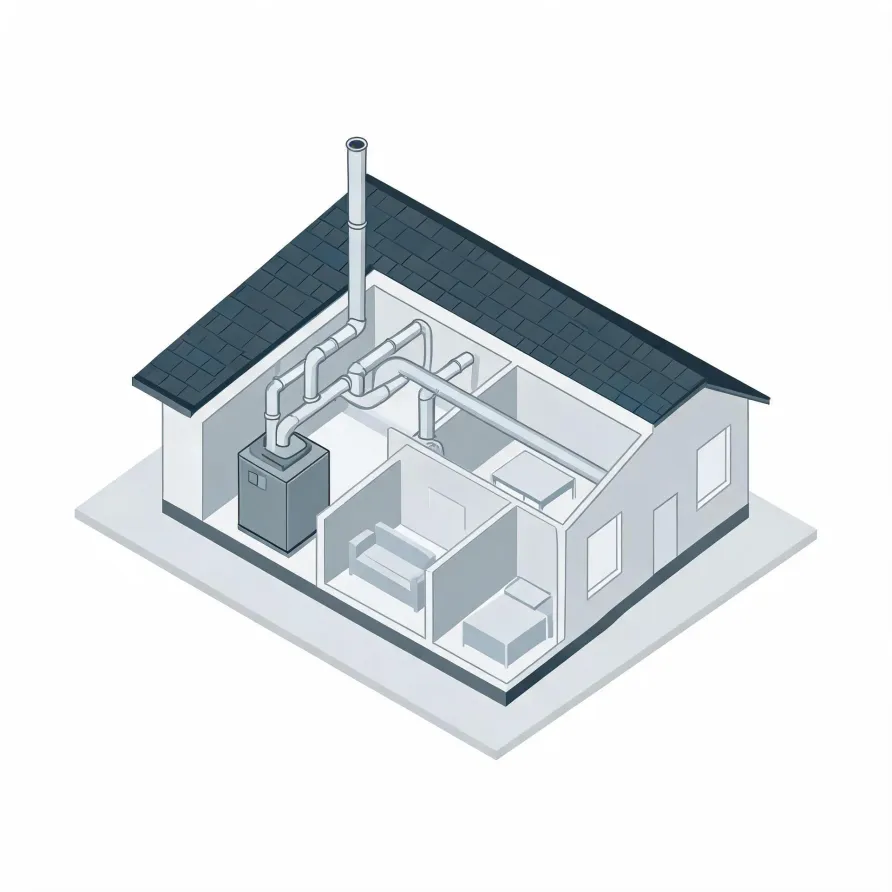
The furnace itself sits in a utility space, basement, or closet and is where heat is actually produced. Inside it, the heat exchanger and the burner assembly are the pieces a contractor looks at when a furnace is misbehaving. A cracked heat exchanger or a burner that is not firing cleanly will stop the system before anything else does.
The blower motor pushes conditioned air out through the supply side and draws return air back in. The flue pipe runs from the furnace to an exterior wall or roof and carries combustion gases out of the house. The thermostat, mounted on a living-area wall, is the control point and is often where a fault first shows up as a symptom.
The drawing shows a typical furnace layout, and a licensed contractor determines what applies to the specific equipment and configuration in your home.
Get matched in Bryan CountyBryan County, Georgia, by the numbers
52 severe weather events were recorded in Bryan County, Georgia between 2015 and 2024.
NOAA National Centers for Environmental Information, Storm Events Database, bulk CSV export, events 2015-01-01 through 2024-12-31.Half the homes in Bryan County, Georgia were built in 2005 or earlier (2020-2024 ACS 5-year).
U.S. Census Bureau, 2020-2024 American Community Survey 5-Year EstimatesBryan County, Georgia holds 17,957 housing units (2020-2024 ACS 5-year).
U.S. Census Bureau, 2020-2024 American Community Survey 5-Year EstimatesOwners occupy 77.7% of the occupied homes in Bryan County, Georgia (2020-2024 ACS 5-year).
U.S. Census Bureau, 2020-2024 American Community Survey 5-Year EstimatesCodes & Standards Governing Furnace and HVAC Repair in Bryan County, Georgia4 sourced rules and standards
What Happens When a Contractor Comes Out
Non-weatherized gas furnaces manufactured on or after November 19, 2015 must reach 80.0 percent AFUE.
Non-weatherized oil-fired furnaces manufactured on or after November 19, 2015 must reach 83.0 percent AFUE.
Mobile home gas furnaces manufactured on or after November 19, 2015 must reach 80.0 percent AFUE.
Non-weatherized gas furnaces manufactured on or after December 18, 2028 must reach 95.0 percent AFUE, up from the 80.0 percent minimum that applies to units manufactured before that date.
Weather Stress on HVAC Equipment in Bryan County
Heating and cooling systems bear the load every time outdoor conditions swing hard. How often that happens here shapes how much wear a furnace in Bryan County accumulates and how frequently repair calls come in.
52 severe weather events, 2015–2024. Source: NOAA National Centers for Environmental Information, Storm Events Database.