Tell us about the job
Takes about a minute. No obligation.
A furnace that stops working in Fannin County almost always has a simpler story behind it than the weather outside. 70 severe weather events were recorded in Fannin County, Georgia between 2015 and 2024. At that rate, severe weather is something a system here encounters now and then, not a chronic load beating on components season after season. A contractor diagnosing a failed heat exchanger, a worn igniter, or a seized blower motor in this county looks first at how old the unit is and whether it has been serviced, because those two factors account for most of what goes wrong. Weather is rarely the answer.
Furnace parts availability is the variable that shapes how a repair job goes in Fannin County. Half the homes in Fannin County, Georgia were built in 1996 or earlier (2020-2024 ACS 5-year). A system running in a house that old is likely several ownership cycles removed from its original install, and the equipment itself may predate current parts distribution. When a contractor opens a furnace here and identifies a failed heat exchanger, inducer motor, or control board, the next call is to suppliers, not to the tool bag. If that component has been discontinued, the repair conversation becomes a replacement conversation, and that shift changes the bill substantially.
The Parts of a Furnace a Contractor Checks First
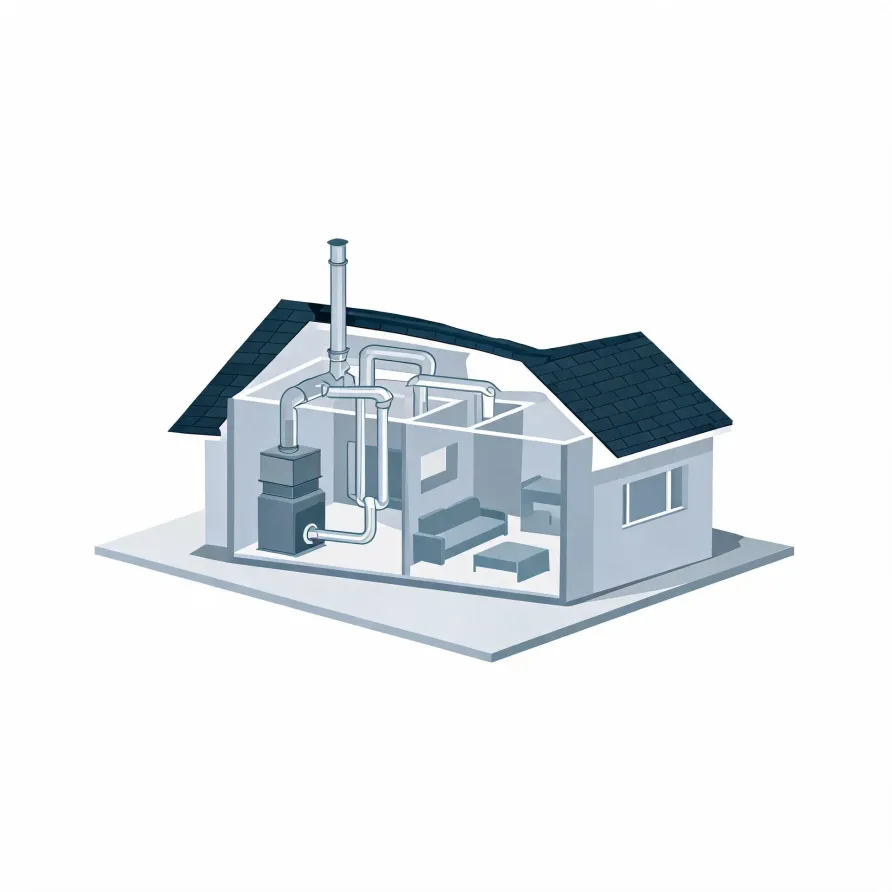
The furnace itself sits in the basement, utility closet, or attic and is the piece a contractor opens first. Inside it, the heat exchanger and burner assembly do the core work, and cracks in the exchanger or a failed burner are common reasons a furnace stops heating properly. The blower motor pulls air across the exchanger and pushes it through the house.
The flue pipe runs from the furnace to the outside and carries combustion gases out of the home. Alongside the furnace sits the air filter housing, which a contractor checks because a blocked filter can starve the system of airflow and cause other components to overheat. The thermostat on the interior wall is where the signal originates, and a faulty one can mimic a furnace problem that is not there.
The drawing shows a typical furnace layout, and a licensed contractor will determine which parts apply to your specific system and what each one needs.
Get matched in Fannin CountyFannin County, by the numbers
70 severe weather events were recorded in Fannin County, Georgia between 2015 and 2024.
NOAA National Centers for Environmental Information, Storm Events Database, bulk CSV export, events 2015-01-01 through 2024-12-31.Half the homes in Fannin County, Georgia were built in 1996 or earlier (2020-2024 ACS 5-year).
U.S. Census Bureau, 2020-2024 American Community Survey 5-Year EstimatesFannin County, Georgia holds 18,490 housing units (2020-2024 ACS 5-year).
U.S. Census Bureau, 2020-2024 American Community Survey 5-Year EstimatesOwners occupy 78.6% of the occupied homes in Fannin County, Georgia (2020-2024 ACS 5-year).
U.S. Census Bureau, 2020-2024 American Community Survey 5-Year EstimatesCodes & Standards Governing Furnace Repair in Fannin County, Georgia4 sourced rules and standards
What the repair visit looks like
Non-weatherized gas furnaces manufactured on or after November 19, 2015 must reach 80.0 percent AFUE.
Non-weatherized oil-fired furnaces manufactured on or after November 19, 2015 must reach 83.0 percent AFUE.
Mobile home gas furnaces manufactured on or after November 19, 2015 must reach 80.0 percent AFUE.
Non-weatherized gas furnaces manufactured on or after December 18, 2028 must reach 95.0 percent AFUE, up from the 80.0 percent minimum that applies to units manufactured before that date.
Severe Weather Events in Fannin County
Hard weather puts real hours on heating equipment. Furnaces that run through temperature swings, power fluctuations, and recovery cycles after storms need repair work done by someone who knows what local conditions actually demand.
70 severe weather events, 2015–2024. Source: NOAA National Centers for Environmental Information, Storm Events Database.