Tell us about the job
Takes about a minute. No obligation.
A furnace breaking down in this area is far more likely a story about age or neglected maintenance than about weather. 38 severe weather events were recorded in Toombs County, Georgia between 2015 and 2024. At that rate, severe weather is an occasional event here rather than a standing condition, which means a contractor diagnosing a furnace repair is not chasing storm-related wear as a first suspect. They are checking heat exchangers, igniters, and filters for the kind of gradual deterioration that builds when a system runs for years without attention. The weather record does not explain most of what goes wrong.
Furnaces in a county's older housing stock tend to run on systems whose replacement parts have had time to go scarce or disappear from distribution entirely. Half the homes in Toombs County, Georgia were built in 1984 or earlier (2020-2024 ACS 5-year). A contractor who opens a furnace here may find a heat exchanger, a gas valve, or an igniter from a model line that suppliers no longer stock, which changes what the repair costs and sometimes whether it goes forward at all. That is the variable a homeowner here is most likely to face when a furnace call gets complicated.
The Parts of a Furnace a Contractor Checks First
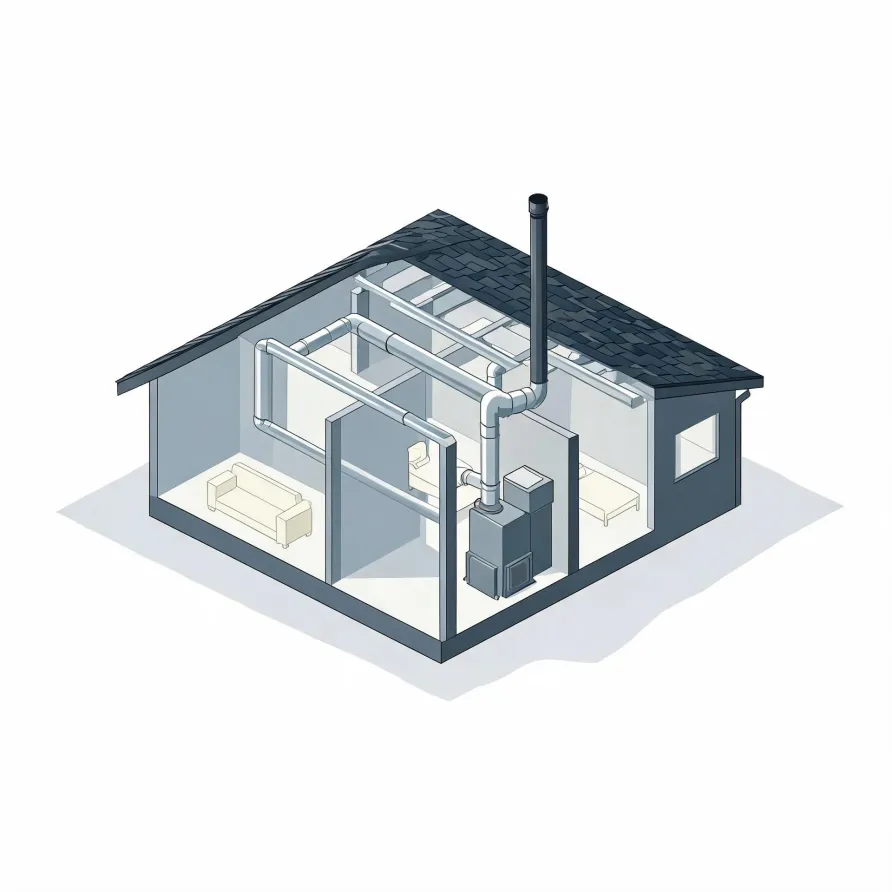
The furnace itself sits in a utility space, basement, or closet and is the piece a contractor goes to first. Inside it, the heat exchanger is the part that fails quietly but seriously, and the burners, igniter, and flame sensor are the components most often behind a furnace that starts and stops or refuses to start at all.
The blower motor sits inside the furnace cabinet and pushes conditioned air into the supply side of the duct system. The flue pipe runs from the furnace up and out of the house, and the thermostat on a living-area wall is the control signal the whole sequence depends on. Both are worth checking when the system misbehaves.
The drawing shows a typical layout, and a licensed contractor determines what applies to your specific equipment and home.
Get matched in Toombs CountyToombs County, by the numbers
38 severe weather events were recorded in Toombs County, Georgia between 2015 and 2024.
NOAA National Centers for Environmental Information, Storm Events Database, bulk CSV export, events 2015-01-01 through 2024-12-31.Half the homes in Toombs County, Georgia were built in 1984 or earlier (2020-2024 ACS 5-year).
U.S. Census Bureau, 2020-2024 American Community Survey 5-Year EstimatesToombs County, Georgia holds 12,103 housing units (2020-2024 ACS 5-year).
U.S. Census Bureau, 2020-2024 American Community Survey 5-Year EstimatesOwners occupy 60.5% of the occupied homes in Toombs County, Georgia (2020-2024 ACS 5-year).
U.S. Census Bureau, 2020-2024 American Community Survey 5-Year EstimatesCodes & Standards Governing Furnace Repair in Toombs County, Georgia4 sourced rules and standards
What HVAC Repair Looks Like in Toombs County
Non-weatherized gas furnaces manufactured on or after November 19, 2015 must reach 80.0 percent AFUE.
Non-weatherized oil-fired furnaces manufactured on or after November 19, 2015 must reach 83.0 percent AFUE.
Mobile home gas furnaces manufactured on or after November 19, 2015 must reach 80.0 percent AFUE.
Non-weatherized gas furnaces manufactured on or after December 18, 2028 must reach 95.0 percent AFUE, up from the 80.0 percent minimum that applies to units manufactured before that date.
Severe Weather Events in Toombs County
Extreme weather puts real strain on furnace components, from heat exchangers to ignition systems, and that wear compounds over time. How hard the weather pushes here shapes how hard the equipment has to work, which makes local conditions a direct factor in repair frequency.
38 severe weather events, 2015–2024. Source: NOAA National Centers for Environmental Information, Storm Events Database.