Tell us about the job
Takes about a minute. No obligation.
A furnace repair in Catoosa County starts with the system's history, not with the season. 65 severe weather events were recorded in Catoosa County, Georgia between 2015 and 2024. At that rate, severe weather is a real but periodic presence, not a constant grind on equipment. A contractor will check the heat exchanger for fatigue, the igniter for wear, and the blower motor for buildup that builds up over years of normal cycling. Those components fail from age and deferred service more often than from weather stress in an area with this kind of record, and a quote that leans on storm load as the explanation probably misses what actually gave out.
Ductwork and wiring are not what complicates a furnace repair here. Half the homes in Catoosa County, Georgia were built in 1993 or earlier (2020-2024 ACS 5-year). A system installed into housing of that vintage has had time to move through its full service life, and what a contractor finds once the heat exchanger or control board is out of the cabinet is whether the part it needs still exists in any supply chain. Discontinued components are the variable that turns a one-visit repair into a longer job, and stock this old puts that question on the table for a meaningful share of calls in this county.
The Parts of a Furnace a Contractor Checks First
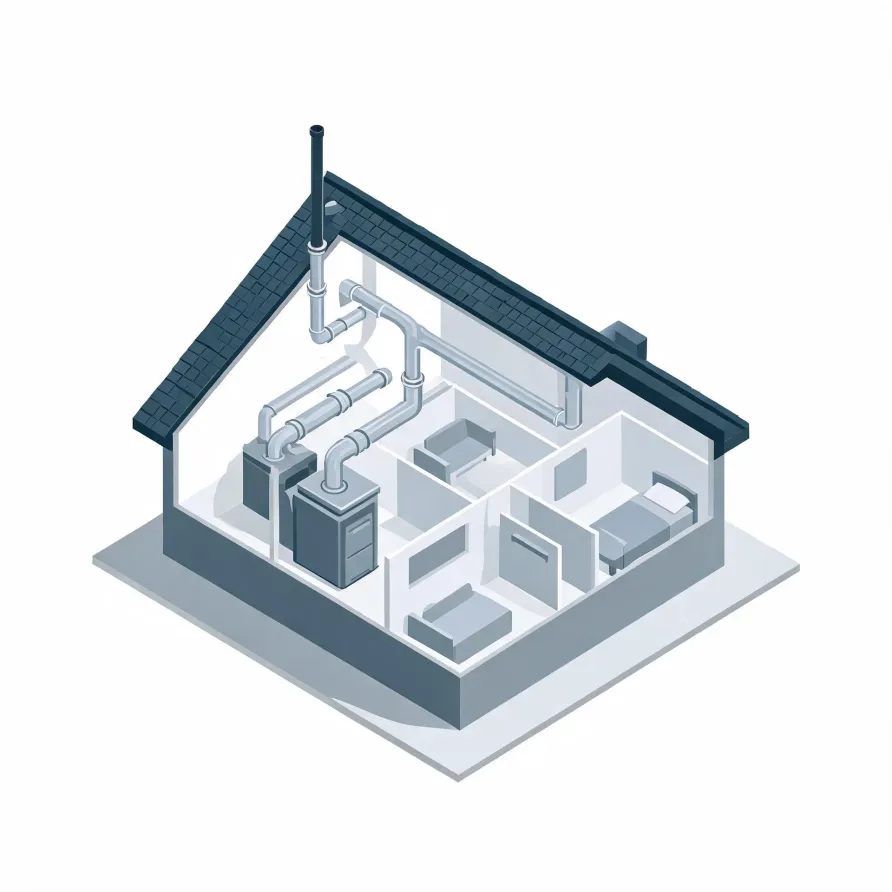
The furnace itself sits in a utility space, basement, or closet and is the piece that generates heat. Inside it, the heat exchanger is the part a contractor goes to early: cracks or failures there let combustion gases into the air supply, and a bad blower motor means that heat never leaves the cabinet at all.
The flue pipe runs from the furnace to the outside and carries exhaust out of the house. The thermostat, mounted on a main living-area wall, sends the call for heat that starts the whole sequence, and a bad signal or failed connection there can make the furnace look broken when the furnace itself is fine.
The drawing shows a typical layout, and a licensed contractor determines which parts apply and what condition they are in for your specific house.
Get matched in Catoosa CountyCatoosa County, by the numbers
65 severe weather events were recorded in Catoosa County, Georgia between 2015 and 2024.
NOAA National Centers for Environmental Information, Storm Events Database, bulk CSV export, events 2015-01-01 through 2024-12-31.Half the homes in Catoosa County, Georgia were built in 1993 or earlier (2020-2024 ACS 5-year).
U.S. Census Bureau, 2020-2024 American Community Survey 5-Year EstimatesCatoosa County, Georgia holds 28,567 housing units (2020-2024 ACS 5-year).
U.S. Census Bureau, 2020-2024 American Community Survey 5-Year EstimatesOwners occupy 74.2% of the occupied homes in Catoosa County, Georgia (2020-2024 ACS 5-year).
U.S. Census Bureau, 2020-2024 American Community Survey 5-Year EstimatesCodes & Standards Governing Furnace and HVAC Repair in Catoosa County, Georgia4 rules & standards
What Happens When the Contractor Arrives
Non-weatherized gas furnaces manufactured on or after November 19, 2015 must reach 80.0 percent AFUE.
Non-weatherized oil-fired furnaces manufactured on or after November 19, 2015 must reach 83.0 percent AFUE.
Mobile home gas furnaces manufactured on or after November 19, 2015 must reach 80.0 percent AFUE.
Non-weatherized gas furnaces manufactured on or after December 18, 2028 must reach 95.0 percent AFUE, up from the 80.0 percent minimum that applies to units manufactured before that date.
Severe Weather Events in Catoosa County
Hard weather puts hours on heating equipment fast. Furnace repair demand in Catoosa County tracks closely with what the sky delivers, which is why local weather history belongs on a page about keeping furnaces running.
65 severe weather events, 2015–2024. Source: NOAA National Centers for Environmental Information, Storm Events Database.