Tell us about the job
Takes about a minute. No obligation.
A contractor pricing a furnace repair in Miller County is almost always chasing age, installation quality, or deferred maintenance rather than weather damage. 48 severe weather events were recorded in Miller County, Georgia between 2015 and 2024. At that rate, severe weather is an occasional event here, not a standing condition, and a system that is failing has most likely been failing for reasons that have nothing to do with storm load. Heat exchangers crack from cycles. Igniters wear from use. A contractor who assumes weather stress is driving the diagnosis in this county is probably looking in the wrong direction first.
Older ductwork and wiring get attention on installation pages, but on a repair call the question that actually decides the job is what the opened furnace contains and whether what it needs is still being made. Half the homes in Miller County, Georgia were built in 1979 or earlier (2020-2024 ACS 5-year). A system that has been running in a house that age has likely been through at least one parts substitution already, and a contractor opening the heat exchanger or the blower assembly may find components that current suppliers no longer stock as originals. That changes the repair from a swap to a fabrication or compatibility problem, and it is the thing a quote has to account for before any price is real.
The Parts of a Furnace a Contractor Checks First
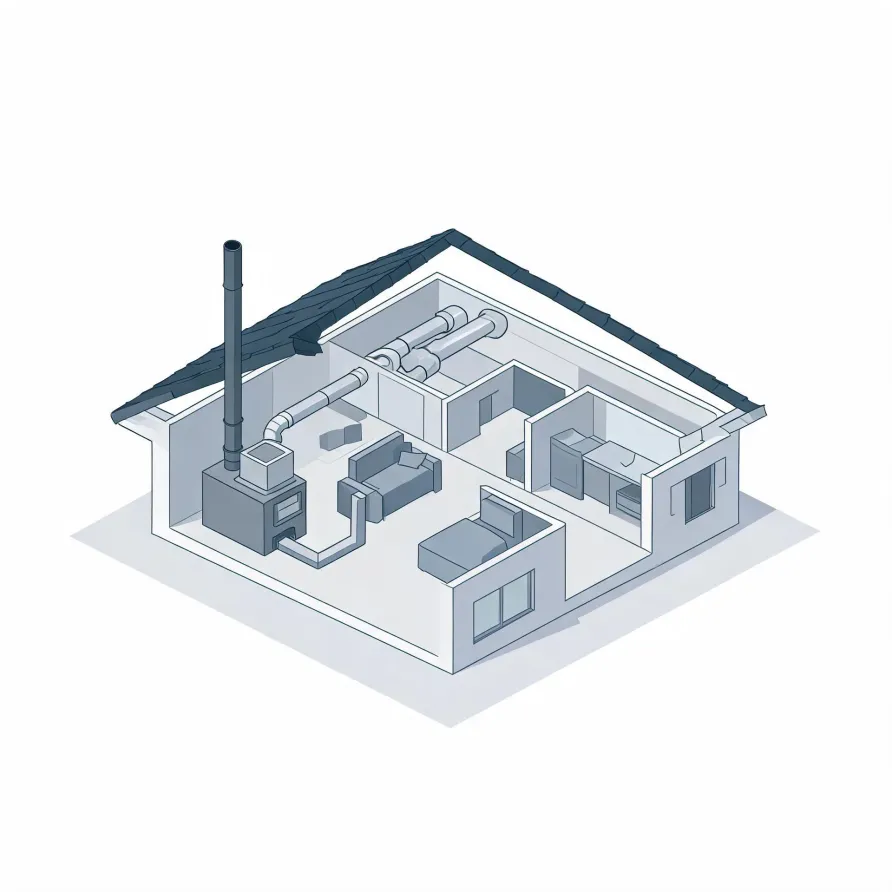
The furnace itself sits in the basement, utility room, or closet and is the piece a contractor opens first. Inside it, the heat exchanger and burner assembly are where most failures begin. A cracked heat exchanger, a dirty burner, or a failed igniter will each kill the system in a different way, and the symptoms tell a contractor which one to pull.
The blower motor pushes conditioned air out through the supply side and draws return air back in. The flue and venting carry combustion gases out of the house, and the control board ties the electrical signals together. Each of these sits in a different spot, and each one fails differently.
The drawing shows a typical furnace layout, and a licensed contractor determines what applies to your specific system.
Get matched in Miller CountyMiller County, Georgia, by the numbers
48 severe weather events were recorded in Miller County, Georgia between 2015 and 2024.
NOAA National Centers for Environmental Information, Storm Events Database, bulk CSV export, events 2015-01-01 through 2024-12-31.Half the homes in Miller County, Georgia were built in 1979 or earlier (2020-2024 ACS 5-year).
U.S. Census Bureau, 2020-2024 American Community Survey 5-Year EstimatesMiller County, Georgia holds 2,856 housing units (2020-2024 ACS 5-year).
U.S. Census Bureau, 2020-2024 American Community Survey 5-Year EstimatesOwners occupy 70.5% of the occupied homes in Miller County, Georgia (2020-2024 ACS 5-year).
U.S. Census Bureau, 2020-2024 American Community Survey 5-Year EstimatesCodes & Standards for Furnace and HVAC Repair in Miller County, Georgia4 sourced rules and standards
What Happens When the Contractor Arrives
Non-weatherized gas furnaces manufactured on or after November 19, 2015 must reach 80.0 percent AFUE.
Non-weatherized oil-fired furnaces manufactured on or after November 19, 2015 must reach 83.0 percent AFUE.
Mobile home gas furnaces manufactured on or after November 19, 2015 must reach 80.0 percent AFUE.
Non-weatherized gas furnaces manufactured on or after December 18, 2028 must reach 95.0 percent AFUE, up from the 80.0 percent minimum that applies to units manufactured before that date.
Severe Weather Events in Miller County
Storm activity puts real hours on heating and cooling equipment. Furnaces that run hard through weather-driven cold snaps, power fluctuations, and recovery cycles wear faster, and repair needs in Miller County reflect what the local climate actually does.
48 severe weather events, 2015–2024. Source: NOAA National Centers for Environmental Information, Storm Events Database.